
Understanding Neck Pain
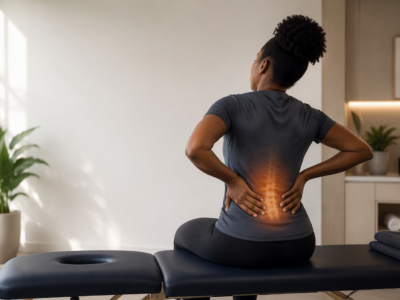
Neck pain is one of the most common conditions we treat at Westway Clinic in Redhill. Whether it’s a stiff neck that won’t turn properly, a dull ache from hours at a desk, or sharp pain that shoots into your shoulder — neck problems can make even simple daily tasks feel difficult.
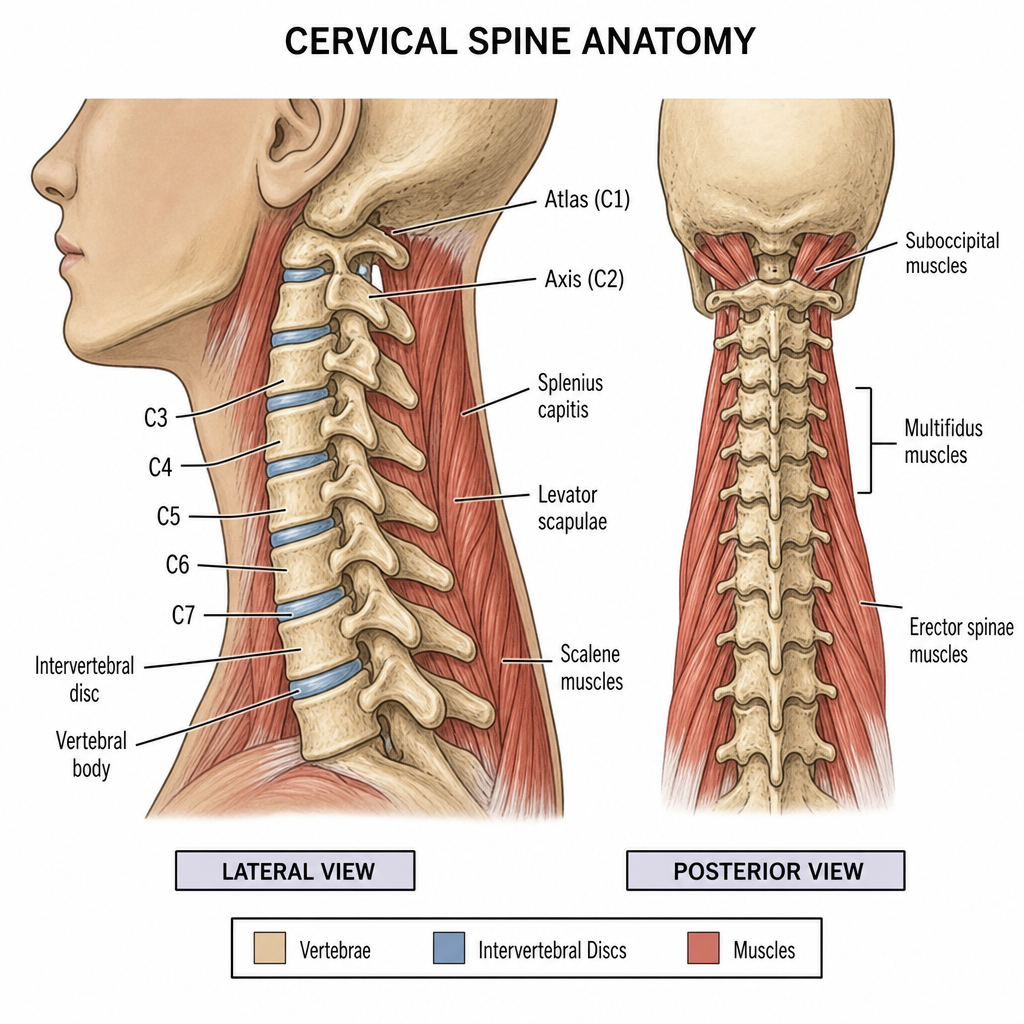
Your neck (cervical spine) supports the weight of your head — roughly 5 kg — and allows it to move in almost every direction. As a result, it relies on a complex arrangement of vertebrae, discs, muscles, and ligaments that can all become sources of pain when they’re strained, compressed, or irritated.
The good news? Most neck pain resolves within a few weeks with the right approach. In particular, neck exercises are one of the most effective ways to relieve stiff neck pain and prevent it returning. This page covers the common causes, the best neck stretches for pain relief, strengthening exercises, therapy neck pain options, and when to seek professional help.
Common Causes of Neck Pain
Common Causes of Neck Pain
Understanding what’s causing your neck pain is the first step toward effective neck pain treatment. The most common causes include:
Poor posture (the biggest culprit): Hours spent looking at screens, phones, or driving pushes the head forward of the spine. For every inch your head moves forward, the load on your neck muscles roughly doubles. This leads to muscle fatigue, stiffness, and pain.
Muscle strain and overuse: Sleeping awkwardly, carrying heavy bags on one shoulder, or holding the phone between ear and shoulder can all strain the neck muscles. Consequently, pain usually develops gradually and worsens through the day.
Stress and tension: Emotional stress causes unconscious muscle tightening — particularly in the upper trapezius and neck muscles. Over time, this creates a persistent aching stiffness that many people describe as “carrying tension in their shoulders.”
Cervical disc problems: The discs between the vertebrae can bulge or degenerate, pressing on nearby nerves. As a result, this may cause neck pain with radiating symptoms into the arm — numbness, tingling, or weakness.
Whiplash and trauma: Sudden acceleration-deceleration injuries (most commonly car accidents) can damage the soft tissues of the neck. Pain often appears 12–24 hours after the event.
Osteoarthritis: Age-related wear in the cervical joints causes stiffness and aching, particularly in the morning or after periods of inactivity. Most common in over-50s.
Other contributing factors include:
- Sedentary lifestyle and weak neck/shoulder muscles
- Poor workstation ergonomics
- Sleeping position (particularly stomach-sleeping)
- Carrying excess weight in the upper body
- Previous neck injuries that weren’t fully rehabilitated
Types of Neck Pain
Understanding your pain type helps guide the right neck pain treatment:
- Mechanical neck pain — the most common type. Caused by posture, strain, or joint stiffness. Usually feels worse with certain movements or positions and better with others. Responds well to exercises and physiotherapy.
- Stiff neck pain — often appears suddenly (e.g., waking with a “locked” neck). Usually caused by muscle spasm or facet joint irritation. Typically resolves within a few days with gentle movement and heat.
- Nerve-related (radicular) pain — shooting pain, numbness, or tingling that travels from the neck into the arm or hand. Caused by nerve compression from a disc bulge or bony narrowing. Needs professional assessment.
- Tension-type pain — dull, bilateral aching across the neck and shoulders, often with associated headaches. Related to stress, fatigue, and muscle overuse.
Neck Exercises for Pain Relief
Neck exercises are one of the most effective strategies for both treating and preventing neck pain. Specifically, they work by reducing muscle tension, improving joint mobility, strengthening supporting muscles, and correcting posture imbalances.
The key principles:
- Start gently — especially if your neck is currently painful
- Move within a comfortable range — don’t push into sharp pain
- Breathe normally throughout
- Aim for little and often — 5 minutes, 3–4 times daily, beats one long session
Stretching Exercises
These stretches target the muscles that become tight from poor posture and stress. They provide immediate relief for stiff neck pain.
Upper trapezius stretch:
- Sit or stand with good posture
- Tilt your head, bringing your right ear toward your right shoulder
- Place your right hand gently on the left side of your head for a mild overpressure
- You’ll feel a stretch along the left side of your neck and shoulder
- Hold for 30 seconds, then switch sides
Levator scapulae stretch:
- Turn your head about 45 degrees to one side
- Look down toward your armpit
- Use your hand on the same side to gently apply pressure downward
- You’ll feel a deeper stretch at the back/side of the neck
- Hold for 30 seconds each side
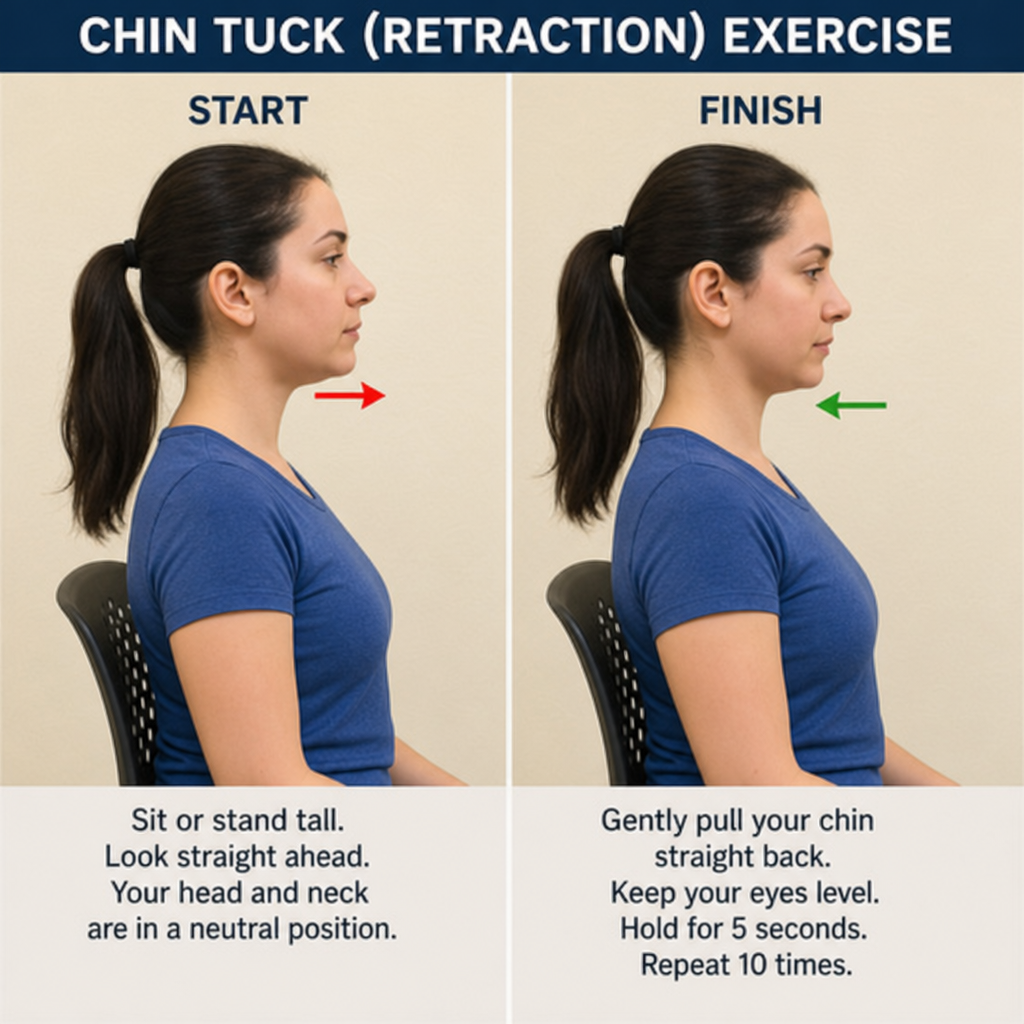
Chin tucks (neck retraction):
- Sit tall with shoulders relaxed
- Draw your chin straight back as if making a “double chin”
- Hold for 5 seconds — you’ll feel a stretch at the base of the skull
- Release and repeat 10 times
This is one of the most important neck exercises — it directly counteracts the forward head posture that causes most neck pain.
Side rotation stretch:
- Sit upright, looking straight ahead
- Slowly turn your head to the right as far as comfortable
- Hold for 15–20 seconds
- Return to centre, then repeat to the left
- 3 repetitions each side
Neck Stretches for Pain
These stretches specifically target pain relief and are safe to do during a flare-up:
Neck tilts (lateral flexion):
- Drop your right ear toward your right shoulder
- Keep both shoulders level — don’t hike the shoulder up
- Hold for 20–30 seconds
- Repeat to the left
Forward flexion stretch:
- Gently lower your chin toward your chest
- You’ll feel a stretch along the back of your neck
- Hold for 20–30 seconds
- Return slowly to neutral
Thread the needle (thoracic rotation):
- On all fours, slide one arm underneath your body
- Allow your upper back to rotate, lowering your shoulder toward the floor
- Hold for 20–30 seconds each side
- This releases the thoracic spine, which directly reduces neck strain
Perform these neck stretches for pain 2–3 times daily. They’re particularly effective first thing in the morning when stiffness is worst.
Strengthening Exercises
Strong neck and shoulder muscles support the cervical spine and reduce the load on joints, discs, and ligaments. These exercises prevent recurrence.
Isometric neck exercises (no movement, just resistance):
- Place your hand against your forehead
- Push your head into your hand without allowing movement — hold 5 seconds
- Repeat with hand on the back of your head (push backward)
- Repeat with hand on each side (push sideways)
- 5 repetitions in each direction, 3 times daily
These are safe even when your neck is painful — there’s no movement, so they don’t aggravate symptoms.
Shoulder blade squeezes:
- Sit or stand with arms by your sides
- Squeeze your shoulder blades together as if holding a pencil between them
- Hold for 5 seconds, then release
- 3 sets of 10 repetitions
Prone Y-raises:
- Lie face down on a bed or floor
- Extend both arms overhead in a Y shape, thumbs pointing up
- Lift your arms 5–10 cm off the surface, squeezing your shoulder blades
- Hold for 3 seconds — 3 sets of 10
These strengthen the lower trapezius and deep neck stabilisers that are often weak in people with neck pain.
Neck Pain Relief Exercises
This combined routine brings together stretching, strengthening, and mobility for comprehensive neck pain relief:
Cat-cow (cervical focus):
- On all fours, slowly arch your back and look upward (cow)
- Then round your back and tuck your chin (cat)
- Focus the movement through your neck and upper back
- 10 slow repetitions
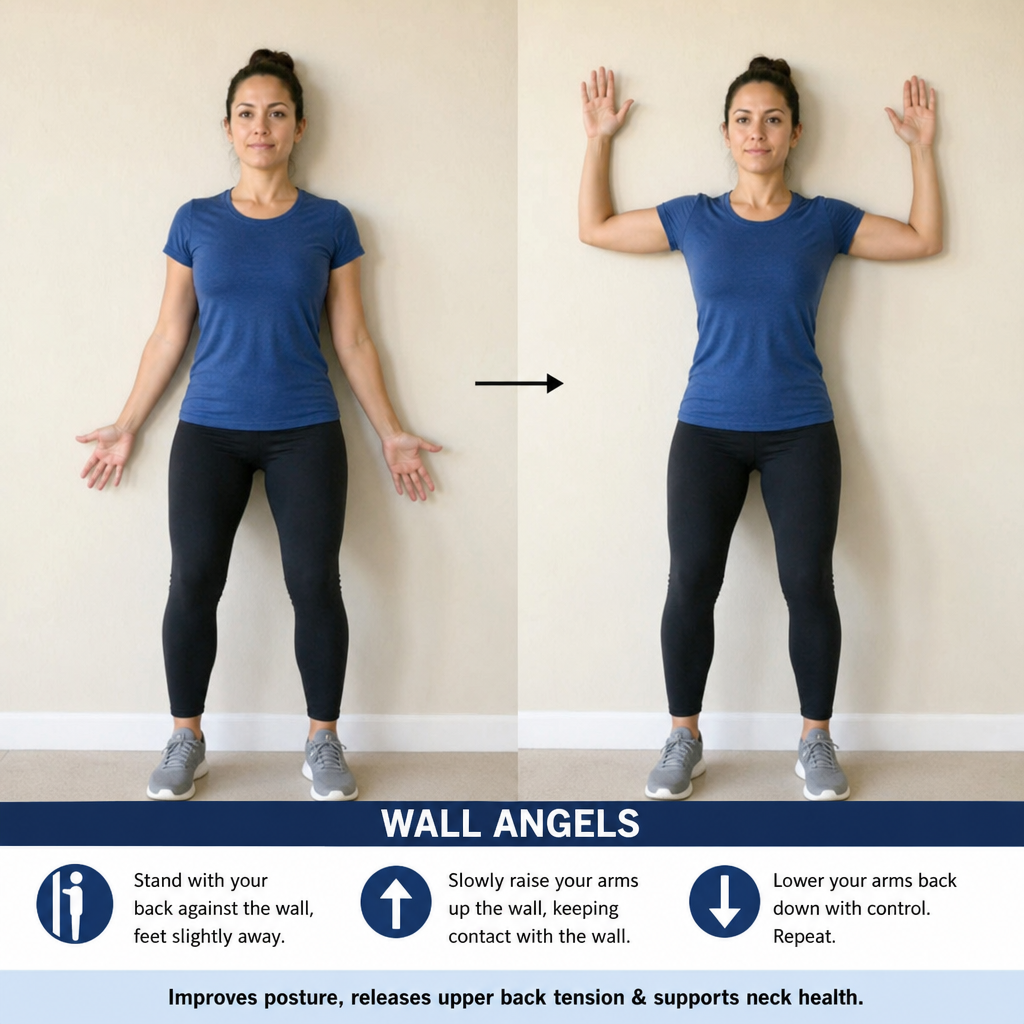
Wall angels:
- Stand with your back against a wall, feet slightly forward
- Place arms against the wall in a “goalpost” position
- Slowly slide arms up and down the wall, keeping contact throughout
- 3 sets of 10 — improves posture and scapular control
Thoracic extension over a rolled towel:
- Roll a bath towel and place it horizontally on the floor
- Lie on your back with the towel positioned at mid-back level
- Extend your arms overhead, allowing your upper back to open over the towel
- Hold for 30–60 seconds, breathing deeply
This releases the thoracic spine, which is often stiff in people with neck pain — reducing the load on the cervical spine above.
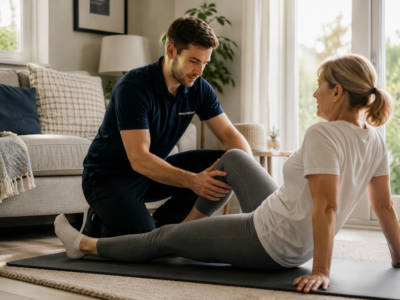
Doing the exercises but not seeing progress? If two or three weeks of consistent effort hasn’t shifted things — or you’re not sure you’re doing them right — that’s exactly when hands-on physiotherapy makes the difference. We’ll refine your technique, add manual therapy, and progress your programme safely.
Therapy and Treatment Options
When neck exercises alone aren’t enough, professional treatment can accelerate recovery and address underlying causes.
Physiotherapy for Neck Pain
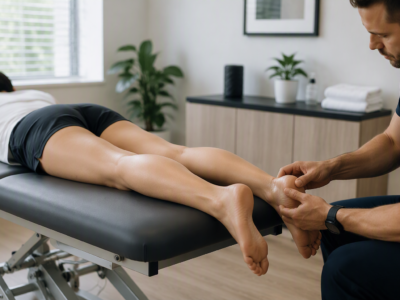
Physiotherapy is the most effective professional treatment for neck pain. At Westway Clinic, physiotherapy for neck pain includes:
- Thorough assessment — identifying which structures are causing pain and why
- Manual therapy — joint mobilisation, soft tissue release, and trigger point work
- Personalised exercise programme — targeted to your specific diagnosis
- Posture correction — workstation advice, sleeping position, and daily habits
- Dry needling or acupuncture — for persistent muscle tension
- Progressive rehabilitation — structured return to full activity
Most patients see significant improvement within 4–6 sessions of physio for neck pain, combined with a daily home exercise programme.
Role of Physio for Neck Strain
Neck strain — whether from an awkward sleeping position, a sudden movement, or whiplash — benefits from early physiotherapy. A physio for neck strain will:
- Assess the severity and rule out anything serious
- Provide hands-on treatment to reduce muscle spasm and restore movement
- Guide you through safe exercises to regain range of motion
- Advise on pain management (ice, heat, medications)
- Monitor recovery and adjust your programme as you improve
Early intervention prevents acute neck strain from becoming chronic. Don’t wait weeks hoping it’ll resolve — the sooner treatment starts, the faster you’ll recover.
How to Cure Neck Pain Fast
For immediate neck pain relief, combine these approaches:
First 48–72 hours:
- Apply ice wrapped in a towel for 15–20 minutes if the pain is acute/inflammatory
- Switch to heat (hot water bottle, heat pad, warm shower) if the pain is more muscular/stiff
- Take ibuprofen (with food) for inflammation, or paracetamol for general pain relief
- Keep moving gently — don’t immobilise the neck in a collar unless medically advised
Quick relief strategies:
- Chin tucks — 10 repetitions every hour at your desk
- Upper trapezius stretches — 30 seconds each side
- Heat application to the upper trapezius and neck
- Gentle neck rotations within a comfortable range
- Posture reset — ears over shoulders, shoulders over hips
For persistent neck pain lasting more than 2–3 weeks, therapy neck pain treatment from a physiotherapist is more effective than self-management alone.
Lifestyle Changes for Long-Term Relief
Workstation and Posture
Most neck pain develops from how you spend 8+ hours a day. Fix these common problems:
- Screen at eye level — the top of your monitor should be at eye height
- Keyboard and mouse close — elbows at 90 degrees, wrists neutral
- Phone use — bring the phone to eye level, don’t drop your head to the phone
- Take breaks — stand and move every 30–45 minutes
- Driving — adjust your headrest and sit upright; don’t crane forward
Sleep Position
- Best: On your back with a supportive pillow that maintains the natural neck curve
- Good: On your side with a pillow thick enough to keep your head level with your spine
- Avoid: Stomach sleeping — it forces the neck into sustained rotation
Stress Management
Since stress directly contributes to neck tension:
- Regular exercise (any type) reduces baseline muscle tension
- Breathing exercises — even 2 minutes of slow diaphragmatic breathing helps
- Progressive muscle relaxation — systematically tensing and releasing muscle groups
- Regular breaks from sustained concentration
When to Seek Professional Help
Most neck pain improves within 2–4 weeks with exercises and self-care. However, certain symptoms need urgent assessment.
Signs You Need Medical Attention
Seek immediate medical attention (A&E) if you experience:
- Neck pain following a significant trauma (fall, car accident, sports collision)
- Progressive weakness in your arms or legs
- Loss of bladder or bowel control
- Severe pain with fever and headache (possible meningitis — especially if you can’t touch chin to chest)
- Sudden onset of dizziness, double vision, or difficulty swallowing with neck pain
See your GP or physiotherapist promptly if:
- Pain has persisted for more than 3–4 weeks with no improvement
- Pain, numbness, or tingling radiating down your arm
- Neck pain is causing regular headaches
- You’re unable to turn your head enough to drive safely
- Pain is severe enough to disturb your sleep regularly
Don’t push through worsening symptoms — early assessment leads to faster recovery.
Ready to get your neck pain sorted? You don’t need to wait weeks to see if it settles. The sooner we assess you, the sooner you recover — and the less likely it is to come back.
Book your neck pain assessment at Westway Clinic, Redhill.
Q&A
Self-Management Questions
Question: Should I wear a neck collar or brace for neck pain?
Short answer: Generally no — prolonged collar use weakens the neck muscles and slows recovery. The evidence strongly favours early gentle movement over immobilisation. The only exceptions are if a doctor has specifically advised a collar following trauma or surgery. For typical mechanical neck pain, keep moving within comfortable limits.
Question: Is it safe to exercise with a stiff neck, or should I wait until the pain goes?
Short answer: Keep moving gently — complete rest typically makes stiff neck pain worse. Start with the gentlest exercises (chin tucks, slow rotations within a comfortable range, upper trap stretches) and progress as the pain settles. Avoid sudden movements or heavy lifting, but light movement promotes blood flow and faster healing.
Related Symptoms
Question: My neck pain comes with headaches — are they related?
Short answer: Very likely. Cervicogenic headaches originate from the upper neck joints and muscles, referring pain into the head — often felt at the base of the skull, behind the eyes, or around the temples. As a result, improving neck mobility and posture through the exercises above often reduces both the neck pain and headaches simultaneously.
Prevention and Daily Habits
Question: How should I set up my desk to prevent neck pain?
Short answer: Screen at eye level (top of monitor at eye height), keyboard close so elbows rest at 90 degrees, feet flat on the floor, and a chair that supports your lower back curve. If using a laptop, add a separate keyboard and raise the screen. In addition, take a movement break every 30–45 minutes — even standing for 30 seconds resets your posture.
Question: Does sleeping position really affect neck pain?
Short answer: Yes — significantly. Back sleeping with a supportive pillow is best, while side sleeping with a thick enough pillow to keep your head level is also good. However, stomach sleeping forces sustained neck rotation and is a common cause of morning stiffness. If you’re a habitual stomach sleeper, transitioning to your side with a body pillow for support can help.
Frequently Asked Questions
-
What is the fastest way to cure neck pain?
Combine ice or heat (depending on whether it’s inflammatory or muscular), gentle stretches (chin tucks, upper trap stretch, rotations), and over-the-counter anti-inflammatories. Most acute neck pain eases significantly within 48–72 hours with this approach. For immediate relief, heat application plus gentle chin tucks every hour is often the most effective combination. -
How often should I do neck exercises?
For active pain: little and often — aim for 5 minutes, 3–4 times daily. Gentle stretches and chin tucks can be done every hour at your desk. For prevention once pain has settled: a 10-minute routine daily, with strengthening exercises 3 times per week. Consistency matters more than duration. -
Is physiotherapy effective for neck pain?
Yes — physiotherapy is one of the most evidence-supported treatments for neck pain. It combines manual therapy (joint mobilisation, soft tissue work), targeted exercises, and posture education. Most patients see significant improvement within 4–6 sessions. It’s particularly effective for persistent pain that hasn’t responded to self-care alone.
-
Can neck pain cause dizziness?
Yes — the cervical spine contains receptors that contribute to balance and spatial awareness. Stiff or dysfunctional upper cervical joints can cause dizziness, lightheadedness, or unsteadiness. This is called cervicogenic dizziness and typically improves with neck physiotherapy. However, new-onset dizziness should always be assessed to rule out other causes.
-
When should I see a doctor for neck pain?
See a professional if pain persists beyond 3–4 weeks, if you have numbness or tingling in your arms, if pain follows a trauma, or if it’s accompanied by headaches, dizziness, or difficulty with coordination. Seek urgent assessment for neck pain with fever, progressive weakness, or bladder/bowel changes.
What our clients say
Key Takeaways
- Most neck pain is caused by posture, muscle strain, or stress — and responds well to exercises
- Chin tucks are the single most important exercise for correcting forward head posture
- Stretch tight muscles (upper trapezius, levator scapulae) and strengthen weak ones (deep neck flexors, lower trapezius)
- Move gently and often — don’t immobilise or rest completely
- Fix your workstation: screen at eye level, breaks every 30–45 minutes
- Physiotherapy for neck pain accelerates recovery when self-care isn’t enough
- Seek urgent help if neck pain follows trauma, comes with arm weakness/numbness, or accompanies fever