
Understanding Knee Pain
Knee pain is one of the most common complaints we see at Westway Clinic in Redhill. Whether it’s a dull ache that builds through the day, a sharp catch going downstairs, or stiffness that makes getting out of a chair feel like hard work — knee problems can stop you doing the things you enjoy.
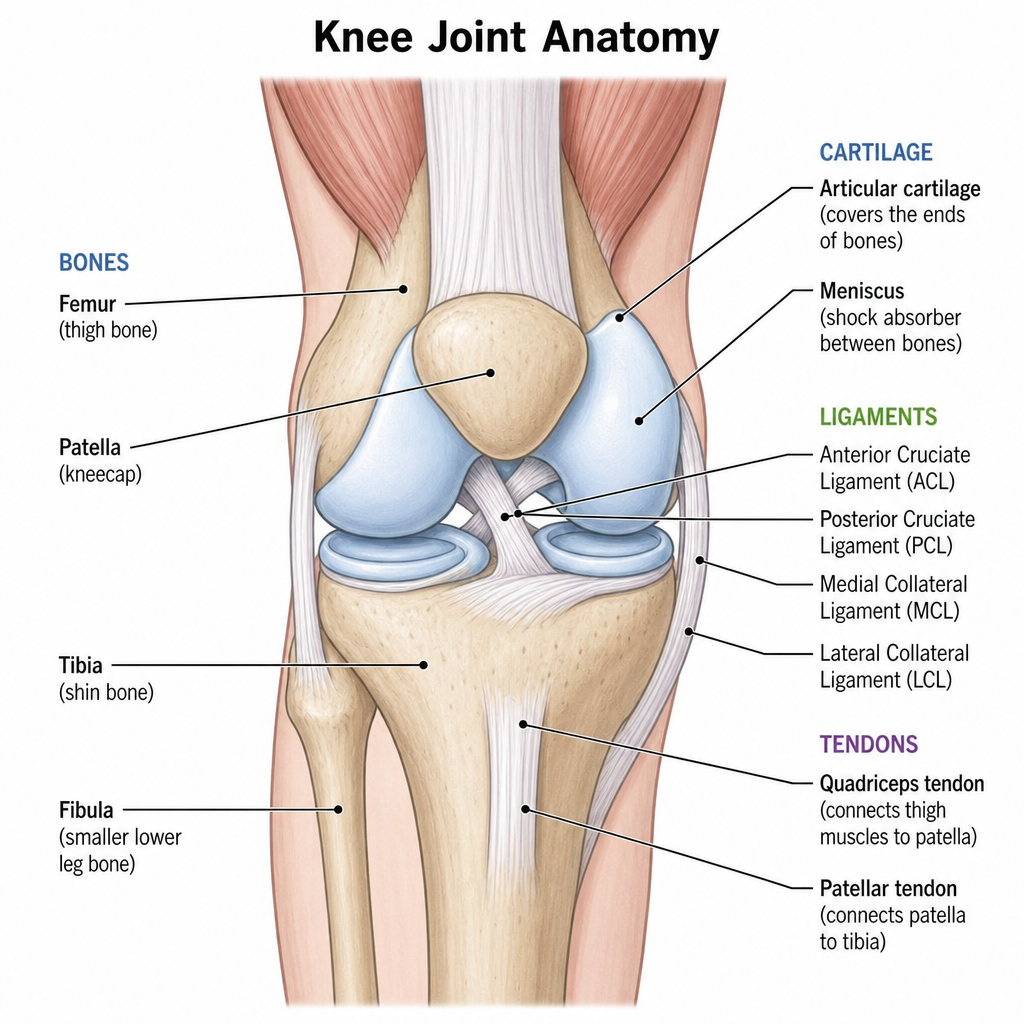
The knee is the largest joint in your body, and it takes enormous forces with every step, squat, and stair. As a result, it relies on a complex network of cartilage, ligaments, tendons, and muscles all working together. When any of these structures are stressed, overloaded, or damaged, pain follows.
The good news? Most knee pain responds well to the right exercises, lifestyle changes, and physiotherapy for knee pain. In most cases, surgery is rarely needed. This page covers the common causes, the best knee pain exercises for knee pain relief, stretches you can start today, knee pain exercises to avoid, and when to seek professional treatment for pain in knee joint problems.
Common Causes of Knee Pain
Knee pain can stem from many different sources. Understanding the cause is the first step toward effective knee pain treatment.
Osteoarthritis (most common in over-50s): The cartilage that cushions the joint gradually wears down, leading to pain, stiffness, and swelling — particularly after periods of inactivity or at the end of the day.
Patellofemoral pain (runner’s knee): Pain around or behind the kneecap, often worse going downstairs, squatting, or sitting for long periods. Common in runners, cyclists, and office workers.
Tendinitis: Inflammation of the tendons around the knee — most often the patellar tendon (below the kneecap) or the quadriceps tendon above it. Usually caused by overuse or sudden increases in activity.
Ligament injuries: ACL, MCL, and other ligament tears typically happen during sport — sudden changes of direction, landing awkwardly, or direct impact.
Bursitis: Inflammation of the fluid-filled sacs (bursae) that cushion the joint. Causes localised swelling and tenderness, often from prolonged kneeling.
Meniscus tears: The rubbery cartilage discs that act as shock absorbers can tear with twisting movements, especially under load. Common in sports but also in older adults with degenerative changes.
Other contributing factors include:
- Excess body weight — every extra kilogram adds roughly 4 kg of force through the knee
- Tight or weak muscles — particularly the quadriceps, hamstrings, and hip muscles
- Poor footwear or biomechanics
- Prolonged inactivity followed by sudden exertion
Types of Knee Pain
Understanding the type of pain helps guide the right knee pain treatment:
- Acute pain — comes on suddenly after an injury or strain. Usually sharp, may involve swelling. Often improves with rest, ice, and careful rehabilitation.
- Chronic pain — develops gradually over weeks or months. Associated with conditions like osteoarthritis or tendinopathy. Requires ongoing management through exercise and lifestyle changes.
- Referred pain — originates elsewhere (commonly the hip or lower back) but is felt in the knee. A physiotherapist can test for this and ensure treatment targets the right area.
Recognising your pain type helps your physiotherapist select the most effective approach for lasting knee pain relief.
Treatment for Pain in Knee Joint
Effective knee pain treatment starts with identifying the cause. A one-size-fits-all approach doesn’t work — what helps osteoarthritis may be wrong for a ligament injury. At Westway Clinic, we assess your specific condition before recommending treatment.
Overview of Treatment Options
Most knee pain responds to conservative (non-surgical) treatment:
- Rest and activity modification — reduce aggravating activities without stopping movement entirely
- Ice — 15–20 minutes with a towel barrier, helpful in the first 48–72 hours after a flare-up
- Heat — for chronic stiffness, apply before exercise to loosen the joint
- Over-the-counter medications — ibuprofen (with food) reduces inflammation; paracetamol for general pain relief; topical anti-inflammatory gels applied directly over the knee
- Knee supports or braces — provide stability and compression during activity
- Weight management — reducing excess weight significantly decreases joint load
- Physiotherapy — the most effective long-term treatment for the majority of knee conditions
For persistent or severe cases, your GP may refer you for imaging (X-ray or MRI), corticosteroid injections, or specialist assessment. Surgery is typically only considered when conservative treatment has been fully explored.
Physiotherapy for Knee Pain
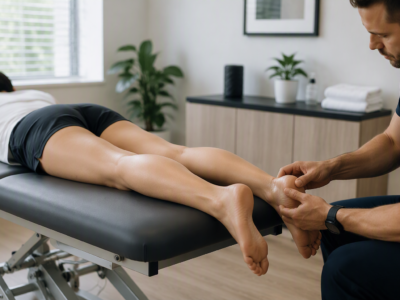
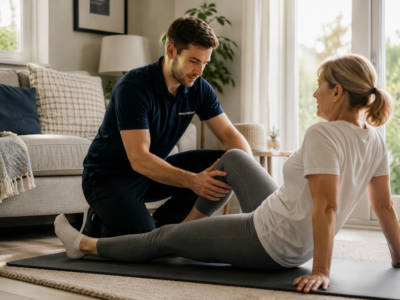
Physiotherapy is the cornerstone of knee pain treatment. Our knee pain physiotherapy addresses both the symptoms and the underlying cause — weak muscles, tight structures, poor movement patterns, or joint stiffness.
At Westway Clinic, physiotherapy for knee pain includes:
- Thorough assessment — identifying which structure is causing pain and why
- Personalised exercise programme — targeted strengthening, stretching, and mobility work
- Manual therapy — hands-on techniques to improve joint movement and reduce stiffness
- Taping or bracing advice — if additional support is needed during recovery
- Activity modification guidance — how to stay active without aggravating the knee
- Progressive return to sport or activity — structured plan to get you back to what you enjoy
Most patients see significant improvement within 4–6 sessions of knee pain physiotherapy (physio for knee pain), combined with a consistent home exercise programme.
Physiotherapy Exercises for Knee Pain
A physiotherapist tailors exercises to your specific diagnosis. A simple physiotherapy exercise for knee pain is the straight leg raise. Here are some commonly prescribed exercises:
Straight leg raises:
- Lie on your back with one knee bent, foot flat, and the other leg straight
- Tighten the thigh muscle of your straight leg
- Lift the straight leg to the height of the bent knee
- Hold for 3–5 seconds, then lower slowly
- 3 sets of 10 each side
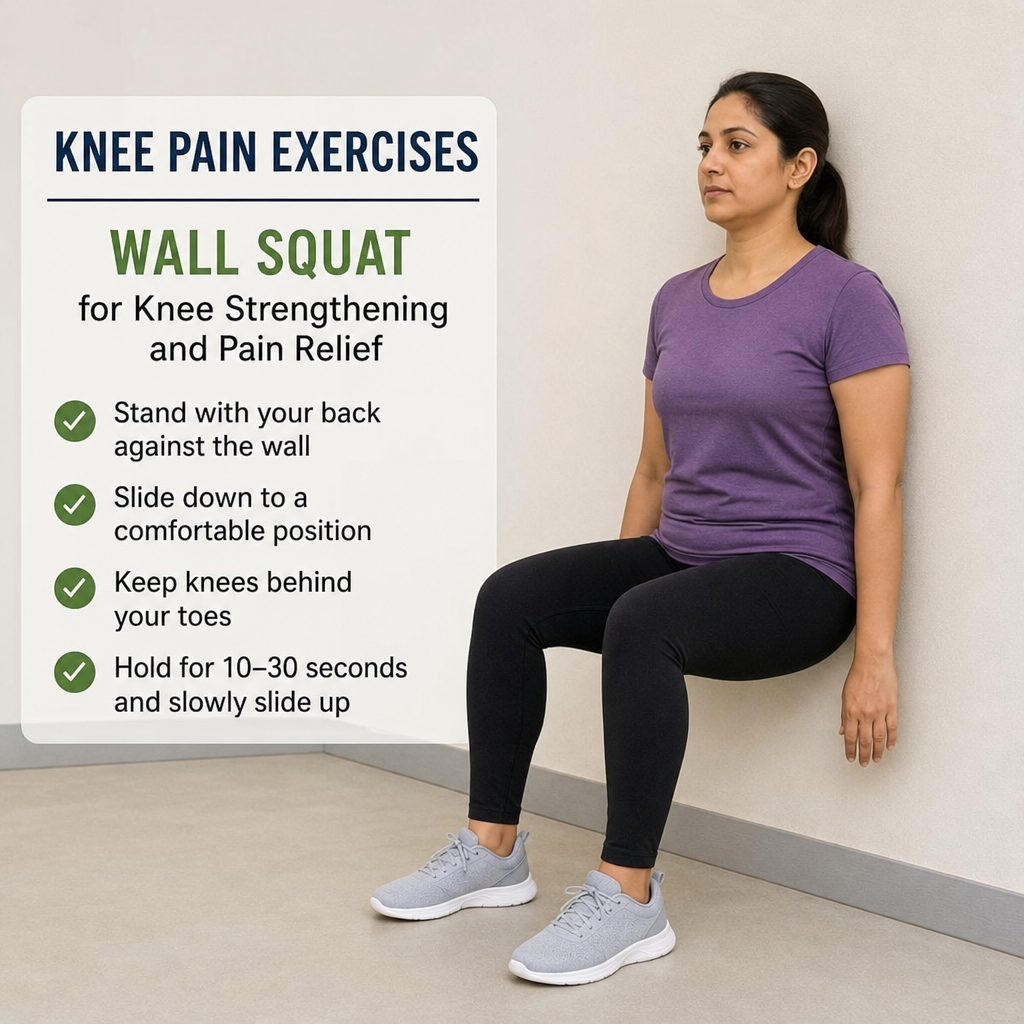
Mini squats (wall-supported):
- Stand with your back against a wall, feet shoulder-width apart and slightly forward
- Slide down the wall until your knees are bent to about 30–45 degrees (not beyond 90)
- Hold for 5–10 seconds
- Slide back up — 3 sets of 10
Hamstring curls (standing):
- Stand holding a chair or worktop for balance
- Slowly bend one knee, bringing your heel toward your buttock
- Hold for 3 seconds at the top
- Lower slowly — 3 sets of 10 each side
Perform these exercises daily during recovery. Mild discomfort is acceptable; sharp pain means stop and modify.
Effective Knee Pain Relief Exercises
Once you’ve been assessed and know what you’re dealing with, exercises become your primary tool for knee pain relief. Research consistently shows that targeted exercise is more effective than rest for most knee conditions.
The best approach combines strengthening (to support the joint), stretching (to reduce stiffness), and avoiding movements that aggravate the problem.
Recommended Knee Pain Exercises
These exercises target the key muscles that support and protect the knee:
Step-ups:
- Stand in front of a step or bottom stair
- Step up with your affected leg, pushing through the heel
- Bring the other foot up to meet it
- Step back down, leading with the unaffected leg
- 3 sets of 10 — increase step height as strength builds
Bridges:
- Lie on your back, knees bent, feet flat and hip-width apart
- Push through your heels to lift your hips
- Hold for 5 seconds at the top — body in a straight line from shoulders to knees
- Lower slowly — 3 sets of 10
Calf raises:
- Stand behind a chair for balance
- Rise up onto your toes, lifting both heels off the floor
- Hold for 2–3 seconds at the top
- Lower slowly — 3 sets of 15
Seated leg extensions:
- Sit on a firm chair with feet flat
- Slowly straighten one knee, lifting the foot until the leg is extended
- Hold for 3–5 seconds, squeezing the thigh muscle
- Lower slowly — 3 sets of 10 each side
Stretches for Knee Pain
Tight muscles around the knee — particularly the quadriceps, hamstrings, calves, and IT band — increase joint stress and worsen pain. Regular stretching reduces stiffness and improves mobility.
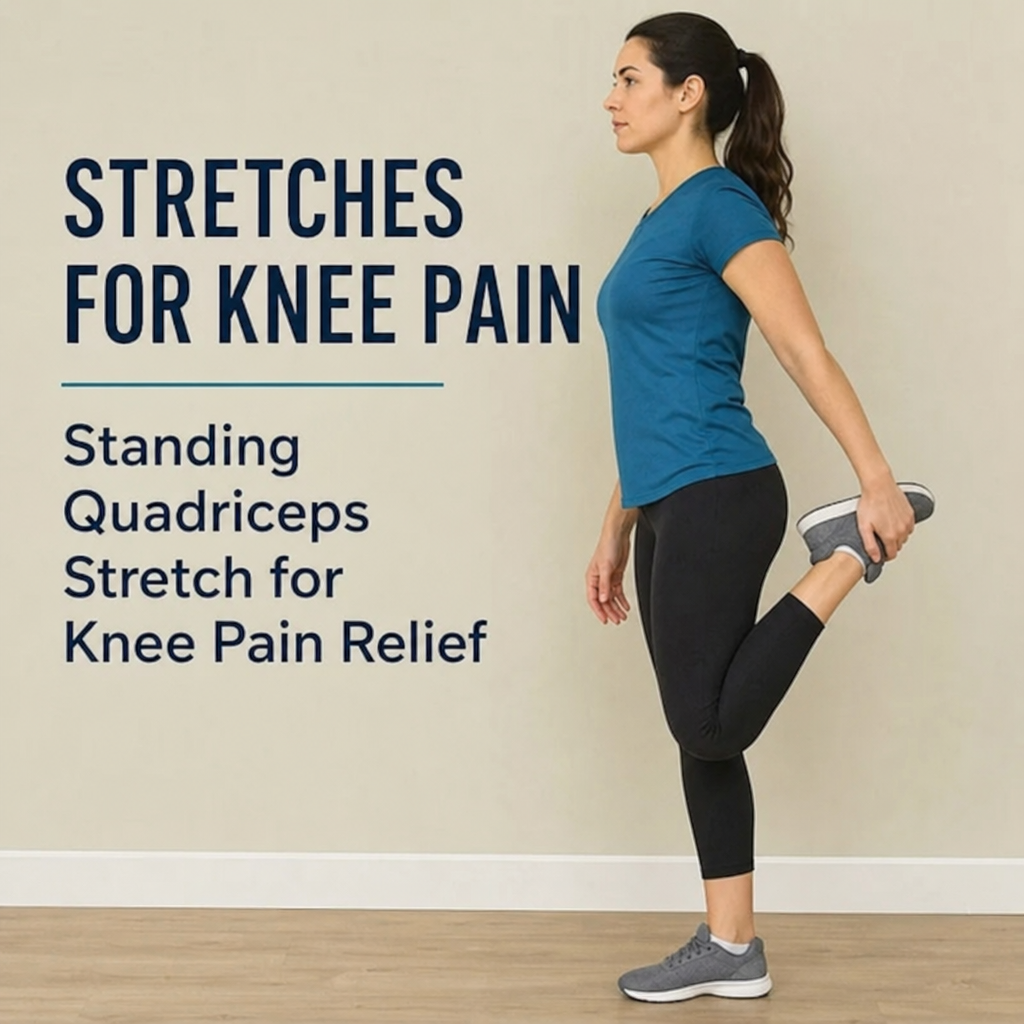
Quadriceps stretch (standing):
- Stand near a wall or chair for balance
- Bend one knee and grab your ankle behind you
- Gently pull your heel toward your buttock
- Keep your knees together and stand tall
- Hold for 30 seconds each side
Hamstring stretch (seated):
- Sit on the edge of a chair
- Extend one leg straight out, heel on the floor, toes pointing up
- Keep your back straight and hinge forward from the hips
- Hold for 30 seconds each side
Calf stretch (wall):
- Stand facing a wall with hands at shoulder height
- Step one foot back, keeping that leg straight and heel on the floor
- Lean into the wall until you feel a stretch in the back of the lower leg
- Hold for 30 seconds each side
IT band stretch (standing cross-leg):
- Stand upright, cross your affected leg behind the other
- Lean your hips away from the affected side
- You’ll feel a stretch along the outer thigh
- Hold for 30 seconds each side
Stretch daily — ideally after a warm-up or at the end of the day. Hold each stretch for 30 seconds minimum, no bouncing.
Specific Exercises for Hurt Knee
If your knee is currently painful or recovering from injury, start with these low-impact exercises for hurt knee that build strength without overloading the joint:
Seated knee extensions (limited range):
- Sit on a chair, straighten the knee only to the point where it’s comfortable
- Don’t force full extension if it causes pain
- Hold for 3 seconds, lower slowly — 3 sets of 10
Heel slides:
- Lie on your back with legs straight
- Slowly slide one heel toward your buttock, bending the knee
- Slide back out — 10–15 repetitions
Static quadriceps hold:
- Sit or lie with your leg straight
- Push the back of your knee down into the floor/bed
- Hold for 5 seconds — you’ll feel the thigh muscle tighten
- Repeat 10 times
Progress gradually — increase range and resistance only when exercises feel comfortable with no increased pain the next day.
Knee Pain Exercises to Avoid
Certain exercises place excessive stress on the knee and can worsen pain. If you’re experiencing knee problems, avoid or modify these:
- Deep squats — bending beyond 90 degrees puts high compressive force through the kneecap
- Lunges with heavy weights — can overload the joint, especially with poor form
- Full-arc leg extensions on a machine — high shear force on the kneecap, particularly in the last 30 degrees of extension
- High-impact jumping — plyometrics and box jumps when the knee is already inflamed
- Running on hard or uneven surfaces — increases impact loading through the joint
- Kneeling for prolonged periods — aggravates bursitis and patellofemoral pain
Replace these with low-impact alternatives: swimming, cycling, cross-trainer work, or the supported exercises described above. A physiotherapist can help you modify your training rather than stopping altogether.
Lifestyle Changes for Long-Term Relief
Exercise alone isn’t always enough. These lifestyle adjustments support your recovery and reduce the risk of knee pain returning.
Doing the exercises but not seeing progress? If two or three weeks of consistent effort hasn’t shifted things — or you’re not sure you’re doing them right — that’s exactly when hands-on physiotherapy makes the difference. We’ll refine your technique, add manual therapy, and progress your programme safely.
Importance of Proper Footwear
Your shoes affect how force travels through your knees with every step. Worn-out or unsupportive footwear can contribute to poor alignment and increased joint stress.
Choose shoes with:
- Adequate arch support for your foot type
- Good cushioning — replace running shoes every 500–800 km
- Proper fit — not too tight, not too loose
- Appropriate heel-to-toe drop for your activity
If you have flat feet, high arches, or overpronation, custom orthotics may help redistribute load away from the knee. Ask your physiotherapist whether this is relevant for you.
Weight Management
Every kilogram of excess body weight adds roughly 4 kg of force through the knee joint during walking. Even modest weight loss (5–10%) can significantly reduce pain and slow the progression of osteoarthritis.
Focus on:
- A balanced diet rich in whole foods, fruit, vegetables, and lean protein
- Regular low-impact activity — walking, swimming, cycling
- Consistency over crash diets — sustainable changes produce lasting results
When to Seek Professional Help
Most knee pain improves with the right exercises and self-care. However, certain symptoms need professional assessment.
Signs You Need Medical Attention
Seek immediate medical attention (A&E) if you experience:
- A loud pop or snap at the time of injury followed by immediate swelling
- Inability to bear any weight on the leg
- Visible deformity of the knee
- The knee locks and you cannot straighten or bend it
See your GP or physiotherapist promptly if:
- Pain has persisted for more than 2–3 weeks with no improvement
- Swelling that doesn’t settle with rest and ice
- The knee gives way or feels unstable
- Pain is severe enough to disturb your sleep
- You have progressive stiffness that’s limiting daily activities
Don’t push through worsening symptoms — early intervention leads to faster recovery and better outcomes.
Ready to get your knee pain sorted? You don’t need to wait weeks to see if it settles. The sooner we assess you, the sooner you recover — and the less likely it is to come back.
Book your knee pain assessment at Westway Clinic, Redhill.
Q&A
Self-Management and Activity
Question: Should I rest completely or keep moving with knee pain?
Short answer: Avoid prolonged rest — it weakens the muscles that support your knee and increases stiffness. Instead, modify your activity: reduce high-impact movements but keep doing gentle exercises like walking, swimming, or the supported exercises described above. Think “relative rest” — protect the knee from aggravating activities while staying active within comfortable limits.
Question: How do I know if my knee pain is serious or will improve on its own?
Short answer: Most knee pain from minor strains or overuse improves within 2–3 weeks with rest, ice, and gentle exercises. Seek professional assessment if pain persists beyond this, if swelling doesn’t settle, if the knee gives way or locks, or if you can’t bear weight. A sudden pop followed by immediate swelling suggests a ligament or meniscus injury and needs prompt evaluation.
Understanding Your Symptoms
Question: Is it normal for my knee to click or crack during exercises?
Short answer: Painless clicking or cracking is common and usually harmless — it’s often caused by gas bubbles in the joint fluid or tendons sliding over bony prominences. However, if clicking is accompanied by pain, swelling, or a catching sensation, it may indicate a meniscus tear or cartilage problem. Have it assessed if it’s painful or getting worse.
Progress and Recovery
Question: How long before I notice improvement from knee exercises?
Short answer: Most people notice some improvement within 2–4 weeks of consistent daily exercise. Significant strength gains typically take 6–8 weeks. Chronic conditions like osteoarthritis require ongoing exercise — the benefits are maintained as long as you keep training. If you’re not seeing any improvement after 3–4 weeks, seek physiotherapy assessment to ensure you’re doing the right exercises for your specific condition.
Question: Can I still run or play sport with knee pain?
Short answer: It depends on the cause and severity. Mild discomfort (2–3 out of 10) that settles within 24 hours is generally safe to continue through. Pain above 4/10, pain that worsens during activity, or swelling afterward means you should reduce or stop and seek assessment. A physiotherapist can help you modify training to stay active while your knee recovers — complete rest is rarely the best approach.
What our clients say
Frequently Asked Questions
-
How long does knee pain take to go away?
It depends on the cause. Minor strains and overuse injuries often improve within 2–4 weeks. Tendinitis may take 6–8 weeks of consistent exercise. Osteoarthritis is a long-term condition that’s managed rather than cured — but the right exercises can significantly reduce pain and improve function. If your knee hasn’t improved after 3–4 weeks of self-care, seek professional assessment.
-
Can exercises really help knee pain, or will they make it worse?
Exercise is the single most effective treatment for most knee conditions — including osteoarthritis. The right exercises strengthen the muscles that support and stabilise the joint, reducing load on damaged structures. The key is choosing appropriate exercises for your specific condition and avoiding those that aggravate it. Start gently and progress gradually.
-
What is the fastest way to relieve knee pain?
For acute flare-ups: rest from aggravating activity, apply ice (15–20 minutes with a towel barrier), elevate the leg, and take ibuprofen if appropriate. Gentle range-of-motion exercises (heel slides, static quads) can begin within 24–48 hours. For chronic knee pain, consistent daily exercise is more effective than any quick fix.
-
Do I need an X-ray or MRI for knee pain?
Not always. Many knee conditions can be accurately diagnosed through a thorough clinical assessment. Your physiotherapist or GP will recommend imaging only if the clinical picture is unclear, if there’s suspicion of a fracture, significant ligament or meniscus injury, or if symptoms aren’t responding to appropriate treatment.
-
When should I consider surgery for knee pain?
Surgery is typically only considered after conservative treatment (physiotherapy, exercise, weight management) has been fully explored — usually a minimum of 3–6 months. Exceptions include acute locked knees, complete ligament ruptures in active individuals, or fractures. The vast majority of knee pain resolves without surgery.
Key Takeaways
- Most knee pain responds well to targeted exercises, physiotherapy, and lifestyle changes — surgery is rarely needed
- Strengthen the quadriceps, hamstrings, and hip muscles to support and protect the knee
- Stretch daily — tight muscles increase joint stress and worsen pain
- Avoid deep squats, heavy lunges, and high-impact activities during recovery
- Proper footwear and healthy weight management reduce long-term knee stress
- Seek professional help if pain persists beyond 2–3 weeks, the knee gives way, or you can’t bear weight
- Physiotherapy for knee pain accelerates recovery and reduces recurrence
Clinically reviewed by Jawad Ahmed, HCPC-registered Physiotherapist, Westway Clinic, Redhill, Surrey. Last updated: July 2025.
Disclaimer: This information is for educational purposes and does not replace individual clinical assessment. If you are experiencing severe or worsening symptoms, please seek professional assessment.