
Understanding Sciatica
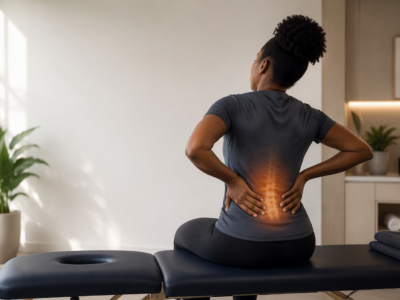
If you’ve ever felt a sharp, burning pain shooting from your lower back down through your buttock and leg, you’ve likely experienced sciatica. It’s one of the most common reasons people visit our physiotherapy clinic in Redhill — and one of the most misunderstood conditions we treat. We provide sciatica physiotherapy to address acute flares and guide recovery with targeted sciatica pain relief strategies.
Sciatica isn’t a diagnosis in itself. It’s a symptom — a sign that your sciatic nerve is being irritated or compressed somewhere along its path. The sciatic nerve is the longest nerve in your body, running from your lower spine through your buttock and down the back of each leg.
The good news? Most sciatica resolves within 4–12 weeks with the right approach. This page covers everything you need: what’s causing your pain, immediate relief for sciatica pain, the best sciatica exercises for recovery, and when physiotherapy or specialist treatment is needed.

What is Sciatica?
Sciatica describes pain that radiates along the path of the sciatic nerve. The pain typically affects one side only and can range from a dull ache to a sharp, electric-shock sensation.
The nerve is formed from five nerve roots in your lower spine (L4, L5, S1, S2, and S3) that merge into one thick nerve — roughly the diameter of your little finger.
Key facts about sciatica:
- Pain, numbness, tingling, or weakness in the leg
- Typically affects one side of the body
- Coughing, sneezing, or sitting for long periods often makes it worse
- Most common between ages 30 and 50
Because the nerve passes through several tight spaces, it’s vulnerable to compression at multiple points — which is why accurate diagnosis matters for effective sciatica treatment.
Common Causes of Sciatica
Understanding the causes of sciatica helps with both treatment and prevention. Several factors can irritate or compress the sciatic nerve:
Disc herniation (most common — roughly 90% of cases): A bulging or ruptured disc in the lower spine presses directly on the nerve root. The gel-like centre of the disc pushes through a weak point and irritates the adjacent nerve.
Spinal stenosis: Narrowing of the spinal canal, usually from age-related changes, reduces the space available for the nerve roots.
Piriformis syndrome: The piriformis muscle deep in the buttock tightens and compresses the sciatic nerve as it passes underneath (or in some people, through) the muscle.
Other potential causes include:
- Degenerative disc disease
- Spondylolisthesis (a vertebra slipping forward)
- Muscle spasm in the lower back or buttock
- Injury or trauma to the spine
You’re more likely to develop sciatica if you sit for long periods, have a physically demanding job involving heavy lifting, are overweight, or have tight hip muscles. Age is also a factor — disc problems are most common between 30 and 50. Addressing these causes helps in finding effective immediate relief for sciatica pain.
Symptoms of Sciatica Pain
Recognising sciatica symptoms helps you act quickly. The hallmark is leg pain that’s worse than any back pain — starting in the lower back or buttock and radiating down the back of one leg.
Additional symptoms may include:
- Tingling or burning sensation in the leg or foot
- Numbness along the nerve pathway
- Muscle weakness — difficulty lifting the foot or pushing off when walking
- Pain that worsens with sitting, coughing, or sneezing
- A shooting pain that makes it difficult to stand up
The sooner you start the right exercises for sciatica, the faster recovery tends to be.
Immediate Relief Techniques
When your leg is on fire and you can’t get comfortable, you need something that works now. These techniques can reduce your pain within minutes to hours and provide practical sciatica pain relief.
Positioning for Pain Relief
The right position takes pressure off the nerve immediately.
Lying on your back with knees elevated:
- Lie flat on your back on a firm surface
- Place a pillow or cushion under your knees so they’re bent at roughly 45 degrees
- This flattens the curve in your lower back, opening the spaces where nerves exit
- Stay here for 15-20 minutes when pain is intense
This is often the single most effective position for immediate sciatica pain relief.
Side-lying with a pillow between your knees:
- Lie on the pain-free side
- Bend both knees slightly
- Place a firm pillow between your knees to keep your spine aligned
The McKenzie press-up (if disc-related):
- Lie face down on the floor
- Place your hands under your shoulders
- Slowly press your upper body up while keeping your hips on the floor
- Hold for 5-10 seconds, then lower back down
- Repeat 5-10 times
This is particularly effective if your sciatica comes from a disc bulge. If this makes your leg pain worse, stop immediately — it may not be suitable for your specific cause.
Ice and Heat Application
Ice (first 48–72 hours of a flare-up):
- Wrap an ice pack in a towel and apply to the lower back or buttock area
- 15–20 minutes on, at least 45 minutes off
- Apply where the nerve is being compressed, not where the pain travels to
Heat (after the initial 48–72 hours, or for chronic sciatica):
- Use a hot water bottle, heat pad, or warm bath
- Apply to the lower back and buttock area for 20–30 minutes
- Relaxes tight muscles, increases blood flow, and reduces stiffness
Many people find alternating 10 minutes of ice followed by 10 minutes of heat works best. Always use a towel as a barrier to protect the skin.
Gentle Stretches for Immediate Relief
These target pressure points along the nerve pathway and promote muscle relaxation. These are simple sciatica stretches you can do at home.
Knee-to-chest stretch:
- Lie on your back with both knees bent, feet flat
- Bring one knee up toward your chest
- Hold behind the thigh (not on the kneecap)
- Pull gently until you feel a mild stretch in your lower back and buttock
- Hold for 20-30 seconds, then switch sides
Piriformis stretch (figure-four):
- Lie on your back with both knees bent
- Cross your affected leg over the other, ankle resting just above the knee
- Reach through and grab behind the supporting thigh
- Pull that thigh toward your chest
- You’ll feel a deep stretch in the buttock of the crossed leg
- Hold for 30 seconds
Seated spinal twist:
- Sit on the floor with legs straight out
- Bend your affected-side knee and cross that foot over your opposite leg
- Place your opposite elbow on the outside of the bent knee
- Gently twist toward the bent knee
- Hold for 20-30 seconds

Pain Relief Medications
Medications are a tool to help you move and exercise — not a long-term solution on their own.
Over-the-counter options:
- Ibuprofen — reduces inflammation around the nerve. Take with food.
- Paracetamol — for general pain relief, can be combined with ibuprofen
- Topical anti-inflammatory gels — applied directly over the lower back or buttock
For stronger pain, your GP can prescribe nerve-specific medication like gabapentin or amitriptyline, higher-dose NSAIDs, or short courses of muscle relaxants. Consult a healthcare professional if pain persists beyond a few days.
Settled the flare but not sure what’s next? These techniques calm the pain — but they can’t tell you which cause is behind it, and the wrong exercise can set you back. A physiotherapy assessment pinpoints the source and gives you a plan built for your body, so you recover faster and it’s less likely to return.
Book a sciatica assessment with Jawad at Westway Clinic, Redhill.
Effective Exercises for Sciatica
Once the acute flare settles (usually after a few days), exercises become your primary treatment. Research consistently shows that staying active and doing targeted exercises leads to faster recovery than bed rest. These sciatica pain exercises are designed to be safe and progressive.
The best exercises for sciatica focus on three things: reducing nerve compression, improving spinal mobility, and building core stability.
Best Exercises for Sciatica Pain Relief
These exercises are particularly effective for reducing sciatica pain. They focus on strengthening and stretching the muscles that support the spine and control pressure on the nerve.
Pelvic tilts:
- Lie on your back, knees bent, feet flat
- Gently flatten your lower back against the floor by tilting your pelvis upward
- Hold for 5 seconds, then release
- Repeat 10-15 times
Bridges:
- Lie on your back, knees bent, feet flat and hip-width apart
- Push through your heels to lift your hips off the floor
- Your body should form a straight line from shoulders to knees
- Hold for 5 seconds at the top
- Lower slowly — 3 sets of 10
Bird-dog:
- On all fours, maintain a neutral spine
- Slowly extend your right arm forward and left leg back simultaneously
- Hold for 5 seconds, keeping your back level
- Return to start, then extend left arm and right leg
- 10 repetitions each side
Knee-to-chest stretch (single and double):
- Lie on your back, bring one knee toward your chest
- Hold behind the thigh for 20-30 seconds
- Switch sides, then bring both knees up together
- This releases tension through the lower back
Beneficial exercises for sciatica pain relief work best when done daily during recovery. These sciatica exercises are most effective when progressed gradually.
Sciatica Stretches to Try
Stretching directly alleviates nerve pressure, enhances flexibility, and reduces stiffness from pain-avoidance postures.
Sciatic nerve glides (nerve flossing):
- Sit on a chair with good posture
- Straighten your affected leg out in front
- Point your toes toward the ceiling while looking up
- Then point your toes away while tucking your chin to your chest
- Alternate smoothly — 10-15 repetitions, gently
Nerve glides reduce adhesions around the nerve and improve its ability to slide freely through surrounding tissues.
Standing hamstring stretch:
- Place one foot on a low step or raised surface
- Keep that leg straight, hinge forward at your hips
- Keep your back straight — don’t round over
- Hold 30 seconds each side
Child’s pose:
- Kneel on the floor, sit back on your heels
- Walk your hands forward, lowering your chest toward the floor
- Hold for 30-60 seconds, breathing deeply
Aim to stretch daily — even 10 minutes makes a difference. Consistency matters more than intensity.

Physiotherapy Exercises for Sciatica
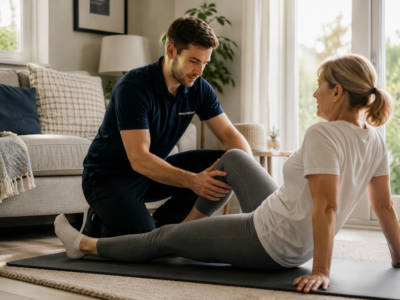
A physiotherapist tailors exercises to your specific diagnosis as part of physiotherapy for sciatica. Common additions include:
McKenzie extensions (prone press-ups):
- Lie face down, hands under shoulders
- Press up, straightening your arms while keeping hips on the floor
- Hold 2–3 seconds at the top
- Lower and repeat 10 times
Do this every 2 hours if your sciatica is disc-related. Pain that “centralises” (moves from the leg back toward the spine) is a good sign.
Core strengthening — dead bugs:
- Lie on your back, arms pointing to the ceiling, knees bent at 90 degrees
- Slowly lower your right arm behind your head while extending your left leg straight
- Keep your lower back pressed against the floor throughout
- Return to start, switch sides — 10 repetitions each
Low-impact aerobics: Walking (start with 10–15 minutes), swimming, or stationary cycling to maintain fitness without aggravating the nerve.
Perform these under guidance initially — your physiotherapist will progress you as symptoms improve.
Doing the exercises but progress has stalled? If two or three weeks of consistent effort hasn’t shifted things — or you’re not sure you’re doing them right — that’s exactly when hands-on physiotherapy makes the difference. We’ll refine your technique, add manual therapy, and progress your programme safely.
Long-Term Sciatica Treatment Options
By addressing root causes — not just symptoms — you minimise future episodes and build a resilient spine. These sciatica treatment strategies help reduce recurrence and improve long-term function.
Lifestyle Changes for Prevention
Fix your sitting posture: Slumping pushes discs backward and increases nerve pressure. Use a lumbar support, keep feet flat, and stand every 30–45 minutes.
Lift properly: Bend at the knees, keep loads close to your body, and avoid twisting while lifting.
Stay active: Walking, swimming, Pilates, and cycling all keep spinal joints mobile and supporting muscles strong. Aim for 30 minutes most days.
Maintain a healthy weight: Every extra kilogram adds load to your spinal discs. Even modest weight loss (5–10%) reduces recurrence risk.
Manage stress: Chronic stress increases muscle tension around the lower back and hips, contributing to nerve compression.
Physiotherapy for Sciatica Pain
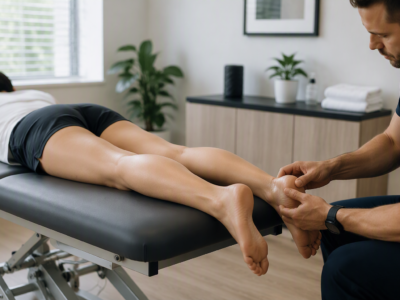
Physiotherapy combines exercises, hands-on treatment, and education — tailored to your individual needs. At Westway Clinic, physiotherapy for sciatica includes:
- Personalised exercise programmes based on your specific diagnosis
- Manual therapy — spinal mobilisation to improve movement in stiff segments
- Soft tissue release — targeted work on piriformis, gluteals, and hamstrings
- Neural mobilisation — techniques that help the nerve move freely
- Body mechanics education — how to sit, lift, and move safely
- Progressive follow-up sessions to advance your programme
Most patients see significant improvement within 4–6 sessions. Professional guidance accelerates recovery far beyond self-management alone. Our sciatica physiotherapy team delivers evidence-based care, and our physiotherapy sciatica pain management plans are tailored to your goals.
Alternative Treatments for Sciatica
Alternative treatments can complement exercises and physiotherapy:
- Acupuncture — reduces pain signalling and releases muscle tension
- Deep tissue massage — releases piriformis, gluteal, and lower back tension
- Yoga and Pilates — builds flexibility, core strength, and spinal control
These work best alongside exercise and physiotherapy rather than as standalone treatments. If you’re comparing treatments sciatica pain options online, we can help you choose evidence-based care tailored to your symptoms.
When to Seek Professional Help
Knowing when to seek professional help for sciatica is crucial. While self-care can be effective for most cases, certain symptoms require urgent medical attention.
Signs You Should See a Doctor
Seek immediate medical attention (A&E) if you experience:
- Loss of bladder or bowel control — inability to urinate, or incontinence
- Numbness around your genitals or saddle area (inner thighs, buttocks, back passage)
- Rapidly worsening weakness in both legs
- Sexual dysfunction that came on suddenly
These are signs of cauda equina syndrome — a rare but serious condition requiring emergency treatment within 24-48 hours to prevent permanent nerve damage. Do not wait for a GP appointment — go to A&E.
See your GP or physiotherapist promptly if:
- Pain has lasted more than 6-8 weeks with no improvement
- Pain is severe enough to prevent sleep
- You have progressive weakness in the leg or foot (foot drop)
- Over-the-counter medication isn’t managing the pain
- You’re unable to work due to symptoms
Don’t wait it out if these apply — earlier intervention means faster recovery and better outcomes.
Ready to get your sciatica sorted? You don’t need to wait six weeks to see if it settles. The sooner we assess you, the sooner you recover — and the less likely it is to come back.
Book your sciatica assessment at Westway Clinic, Redhill.
Q&A
Managing a Sciatica Flare
Question: Should I rest completely or keep moving during a sciatica flare?
Short answer: Avoid full bed rest. Use pain-relief positions (like lying on your back with knees elevated) for short periods when pain is intense, then keep gently active. Begin with the immediate relief stretches (knee-to-chest, piriformis/figure-four) and short walks as tolerated. Research shows staying active and progressing into targeted exercises after a few days leads to faster recovery than resting.
Question: Where should I apply ice or heat, and can I alternate them?
Short answer: Apply ice or heat to the lower back/buttock area where the nerve is being compressed, not down the leg where pain travels. Use ice for the first 48–72 hours (15–20 minutes on, at least 45 minutes off). After that, switch to heat for 20–30 minutes to relax muscles and reduce stiffness. Many people benefit from alternating 10 minutes of ice with 10 minutes of heat. Always place a towel between your skin and the pack.
Exercise and Recovery
Question: How often should I do McKenzie press-ups, and when should I stop?
Short answer: McKenzie press-ups help most when sciatica is disc-related. Perform sets of 10 reps, holding at the top for a few seconds, and you can repeat every 2 hours during the day. Stop immediately if your leg pain worsens or travels further down the leg. Pain that “centralises” (moves from the leg back toward the lower back/buttock) is a good sign—continue if this happens. If press-ups consistently aggravate symptoms, choose other exercises and seek guidance.
Question: How do I know my exercises are helping, and how should I progress them?
Short answer: Signs they’re helping include symptoms easing over 24–48 hours and pain centralising toward the back. Mild discomfort (around 3–4/10) during exercise is acceptable, but sharp, shooting, or spreading leg pain means stop and modify. Check the next morning—if you’re clearly worse, scale back. Progress gradually: increase range of motion or repetitions first, then add resistance later. Consistency (daily practice) matters more than intensity.
Medication Questions
Question: Is it okay to take ibuprofen and paracetamol together for sciatica pain?
Short answer: Yes. Ibuprofen (anti-inflammatory) and paracetamol (pain relief) can be combined; take ibuprofen with food. Topical anti-inflammatory gels over the lower back/buttock can also help. If over-the-counter options don’t control pain after a few days, consult your GP—nerve-targeting medications, higher-dose anti-inflammatories, or short courses of muscle relaxants may be appropriate.
Frequently Asked Questions
-
How long does sciatica take to go away?
Most episodes improve within 4–12 weeks. Mild cases where pain is mainly in the buttock often resolve within 2–4 weeks with the right exercises. More severe cases involving disc herniation may take 8–12 weeks. If your sciatica hasn’t improved after 6–8 weeks of consistent exercise, seek professional assessment.
-
Can exercises help reduce sciatica pain?
Yes — exercise is the most effective treatment for sciatica. Specific stretches reduce nerve pressure, strengthening exercises build core and gluteal support, and nerve glides help the sciatic nerve move freely. The key is choosing the right exercises for your specific cause and doing them consistently.
-
What is the fastest way to get immediate relief for sciatica pain?
Lying on your back with knees elevated on a pillow takes pressure off the nerve within minutes. Combine this with ice application (15–20 minutes) and gentle knee-to-chest stretches. If your sciatica is disc-related, McKenzie press-ups can provide rapid relief by encouraging disc material away from the nerve.
-
When should I consider surgery for sciatica?
Surgery is a last resort — over 90% of cases resolve without it. It’s typically only considered if you have progressive neurological symptoms (worsening weakness, bladder or bowel issues) or severe pain persisting despite 6–12 months of consistent conservative treatment. The most common procedure is a microdiscectomy.
-
How can I prevent sciatica coming back?
Maintain core stability exercises (planks, bird-dogs, bridges) 2–3 times per week, stretch your hips and hamstrings daily, lift with proper technique, and stay generally active. People who maintain their exercise programme after recovery have significantly lower recurrence rates.
What our clients say
Key Takeaways
- Sciatica is nerve pain caused by compression of the sciatic nerve, usually from a disc problem
- For immediate relief: lie with knees elevated, apply ice (first 48 hours) then heat, try knee-to-chest and piriformis stretches
- The best exercises for sciatica combine nerve glides, core stability work, and progressive stretching
- Stay active — bed rest makes sciatica worse
- Most cases resolve within 4–12 weeks with consistent exercise
- Seek immediate help for bladder/bowel changes or saddle area numbness (cauda equina syndrome)
- Physiotherapy for sciatica accelerates recovery and reduces recurrence
Clinically reviewed by Jawad Ahmed, HCPC-registered Physiotherapist, Westway Clinic, Redhill, Surrey. Last updated: July 2026.
Disclaimer: This information is for educational purposes and does not replace individual clinical assessment. If you are experiencing severe or worsening symptoms, please seek professional assessment.