

Understanding Shoulder Pain
Shoulder pain is one of the most common musculoskeletal complaints we treat at Westway Clinic in Redhill. Whether it’s a sharp catch when reaching overhead, a deep ache that disturbs your sleep, or stiffness that makes putting on a coat feel impossible — shoulder problems can significantly affect your daily life.
The shoulder is the most mobile joint in your body, which also makes it the most vulnerable to injury. As a result, it relies on a complex system of muscles (particularly the rotator cuff), tendons, ligaments, and a shallow socket to maintain stability while allowing enormous range of movement. When any of these structures are overloaded, inflamed, or damaged, pain follows.
The good news? Most shoulder pain responds well to the right exercises and physiotherapy for shoulder pain — without surgery. In particular, this page covers the common causes, the best shoulder pain exercises for relief, specific exercises for shoulder tendonitis and impingement, rotator cuff injury treatment options, and when to seek professional help.
Common Causes of Shoulder Pain
Understanding the cause of your shoulder pain is the first step toward effective shoulder pain treatment. The most common causes include:
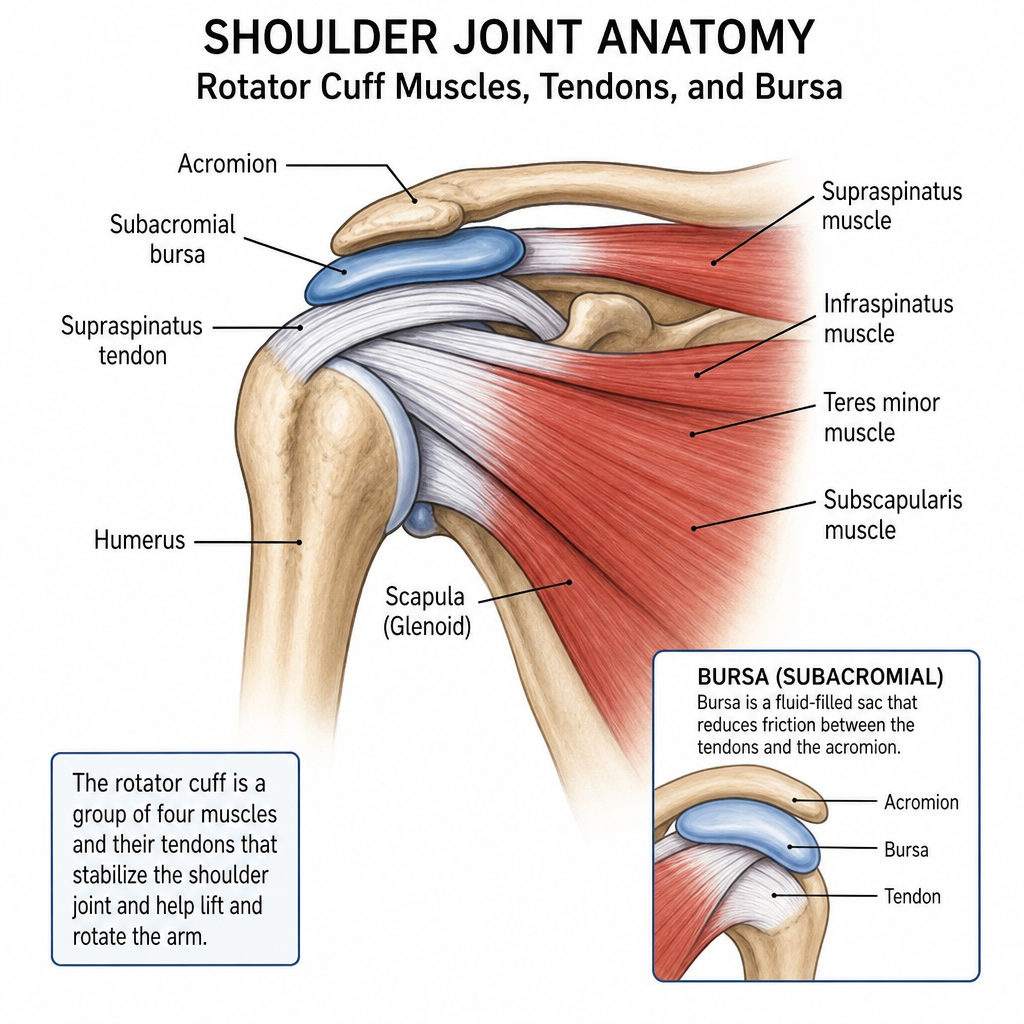
Rotator cuff tendinopathy (most common): The rotator cuff is a group of four muscles and tendons that stabilise the shoulder. Repetitive overhead movements, age-related changes, or sudden overload can cause these tendons to become irritated, thickened, or partially torn. Pain is typically felt on the outer shoulder and worsens with reaching, lifting, or lying on that side.
Shoulder impingement: The tendons and bursa at the top of the shoulder become pinched between the bones when you raise your arm. Consequently, this causes a painful arc — pain between about 60–120 degrees of arm elevation. Often related to posture, weak rotator cuff, or repetitive overhead activity.
Shoulder tendonitis: Inflammation or irritation of the tendons around the shoulder — most commonly the supraspinatus or biceps tendon. Pain worsens with activity and may ache at rest. Common in people who do repetitive reaching or lifting.
Frozen shoulder (adhesive capsulitis): The joint capsule tightens and thickens, causing progressive stiffness and pain. Over time, it develops gradually over weeks to months. Most common in 40–60 year olds and those with diabetes.
Rotator cuff tears: Partial or full-thickness tears of the rotator cuff tendons. Can occur from a single injury (fall, heavy lift) or gradually from wear over time. Causes weakness and pain with lifting or reaching.
Acromioclavicular (AC) joint problems: Pain at the top of the shoulder where the collarbone meets the shoulder blade. Often from falls, contact sports, or repetitive overhead loading.
Other contributing factors:
- Poor posture — rounded shoulders push the shoulder blade forward, reducing space for tendons
- Weak rotator cuff and scapular muscles
- Repetitive overhead activities (painting, swimming, throwing sports)
- Age — tendon quality decreases from the mid-40s
- Sudden increase in activity level
Importance of Early Treatment
Shoulder pain that’s ignored or poorly managed tends to worsen. Specifically, compensating for pain changes how you move, leading to stiffness, muscle weakness, and sometimes frozen shoulder. Early intervention with the right exercises and shoulder pain treatment prevents simple problems from becoming complex ones.
Shoulder pain is one of the most common musculoskeletal complaints we treat at Westway Clinic in Redhill. Whether it’s a sharp catch when reaching overhead, a deep ache that disturbs your sleep, or stiffness that makes putting on a coat feel impossible — shoulder problems can significantly affect your daily life.
The shoulder is the most mobile joint in your body, which also makes it the most vulnerable to injury. As a result, it relies on a complex system of muscles (particularly the rotator cuff), tendons, ligaments, and a shallow socket to maintain stability while allowing enormous range of movement. When any of these structures are overloaded, inflamed, or damaged, pain follows.
The good news? Most shoulder pain responds well to the right exercises and physiotherapy for shoulder pain — without surgery. In particular, this page covers the common causes, the best shoulder pain exercises for relief, specific exercises for shoulder tendonitis and impingement, rotator cuff injury treatment options, and when to seek professional help.
Common Causes of Shoulder Pain
Understanding the cause of your shoulder pain is the first step toward effective shoulder pain treatment. The most common causes include:
Rotator cuff tendinopathy (most common): The rotator cuff is a group of four muscles and tendons that stabilise the shoulder. Repetitive overhead movements, age-related changes, or sudden overload can cause these tendons to become irritated, thickened, or partially torn. Pain is typically felt on the outer shoulder and worsens with reaching, lifting, or lying on that side.
Shoulder impingement: The tendons and bursa at the top of the shoulder become pinched between the bones when you raise your arm. Consequently, this causes a painful arc — pain between about 60–120 degrees of arm elevation. Often related to posture, weak rotator cuff, or repetitive overhead activity.
Shoulder tendonitis: Inflammation or irritation of the tendons around the shoulder — most commonly the supraspinatus or biceps tendon. Pain worsens with activity and may ache at rest. Common in people who do repetitive reaching or lifting.
Frozen shoulder (adhesive capsulitis): The joint capsule tightens and thickens, causing progressive stiffness and pain. Over time, it develops gradually over weeks to months. Most common in 40–60 year olds and those with diabetes.
Rotator cuff tears: Partial or full-thickness tears of the rotator cuff tendons. Can occur from a single injury (fall, heavy lift) or gradually from wear over time. Causes weakness and pain with lifting or reaching.
Acromioclavicular (AC) joint problems: Pain at the top of the shoulder where the collarbone meets the shoulder blade. Often from falls, contact sports, or repetitive overhead loading.
Other contributing factors:
- Poor posture — rounded shoulders push the shoulder blade forward, reducing space for tendons
- Weak rotator cuff and scapular muscles
- Repetitive overhead activities (painting, swimming, throwing sports)
- Age — tendon quality decreases from the mid-40s
- Sudden increase in activity level
Importance of Early Treatment
Shoulder pain that’s ignored or poorly managed tends to worsen. Specifically, compensating for pain changes how you move, leading to stiffness, muscle weakness, and sometimes frozen shoulder. Early intervention with the right exercises and shoulder pain treatment prevents simple problems from becoming complex ones.
Shoulder Tendonitis Explained
Shoulder tendonitis is one of the most common causes of shoulder pain we see at Westway Clinic. Understanding it helps you choose the right exercises and treatment approach.
Symptoms of Shoulder Tendonitis
- Pain on the outer or front of the shoulder
- Pain that worsens when lifting your arm, reaching overhead, or behind your back
- Aching at night — particularly when lying on the affected side
- Pain that develops gradually (not from a single injury)
- Stiffness in the morning that eases with movement
- Weakness when lifting or rotating the arm
Causes of Shoulder Tendonitis
Tendonitis develops when tendons are repeatedly loaded beyond their capacity to recover:
- Repetitive overhead movements — painting ceilings, swimming, throwing sports
- Poor posture — forward head and rounded shoulders reduce tendon space
- Age-related changes — tendon blood supply decreases, making them more vulnerable
- Sudden increase in activity — weekend warriors who overdo it
- Weak rotator cuff — muscles can’t control the humeral head properly, leading to impingement
Diagnosing Shoulder Tendonitis
A physiotherapist can typically diagnose shoulder tendonitis through a thorough clinical assessment — specific tests that stress individual tendons and reproduce your pain. Imaging (ultrasound or MRI) is only needed if symptoms don’t respond to treatment or if a significant tear is suspected.
Effective Shoulder Pain Exercises
The right exercises are the most effective treatment for most shoulder conditions. They reduce pain, restore movement, strengthen the rotator cuff, and correct the muscle imbalances that caused the problem.
Exercises for Shoulder Tendonitis
These shoulder tendonitis exercises target the rotator cuff and scapular muscles — addressing both pain and the underlying cause:
Isometric external rotation (pain-relief starting point):
- Stand with your elbow bent to 90 degrees, arm by your side
- Place the back of your hand against a door frame or wall
- Push outward into the frame without any movement — hold for 10 seconds
- 5 repetitions, 3 times daily
This is safe even when your shoulder is painful — there’s no movement to aggravate the tendon.
Side-lying external rotation:
- Lie on your pain-free side with a small towel rolled under your upper arm
- Bend your top elbow to 90 degrees, forearm resting across your stomach
- Slowly rotate your forearm upward toward the ceiling
- Lower slowly — 3 sets of 10
Eccentric supraspinatus (empty can lowering):
- Stand with your arm raised to shoulder height, angled 30 degrees forward, thumb pointing down
- Use your other hand to help lift the arm up
- Slowly lower the arm under control over 3–5 seconds
- 3 sets of 10
Progress to lifting without assistance once pain allows.
Stretching Exercises
Tight muscles around the shoulder restrict movement and increase tendon stress. These stretches restore flexibility:
Cross-body stretch (posterior capsule):
- Bring your affected arm across your body at shoulder height
- Use your other hand to gently pull it closer to your chest
- You’ll feel a stretch at the back of the shoulder
- Hold for 30 seconds, repeat 3 times
Doorway pec stretch:
- Stand in a doorway with your forearm on the frame, elbow at shoulder height
- Step forward until you feel a stretch across your chest and front of shoulder
- Hold for 30 seconds each side
Sleeper stretch (internal rotation):
- Lie on your affected side with your arm at 90 degrees in front
- Use your other hand to gently push your forearm toward the floor
- Stop when you feel a comfortable stretch at the back of the shoulder
- Hold for 30 seconds
Strengthening Exercises
Strong rotator cuff and scapular muscles are essential for long-term shoulder pain relief:
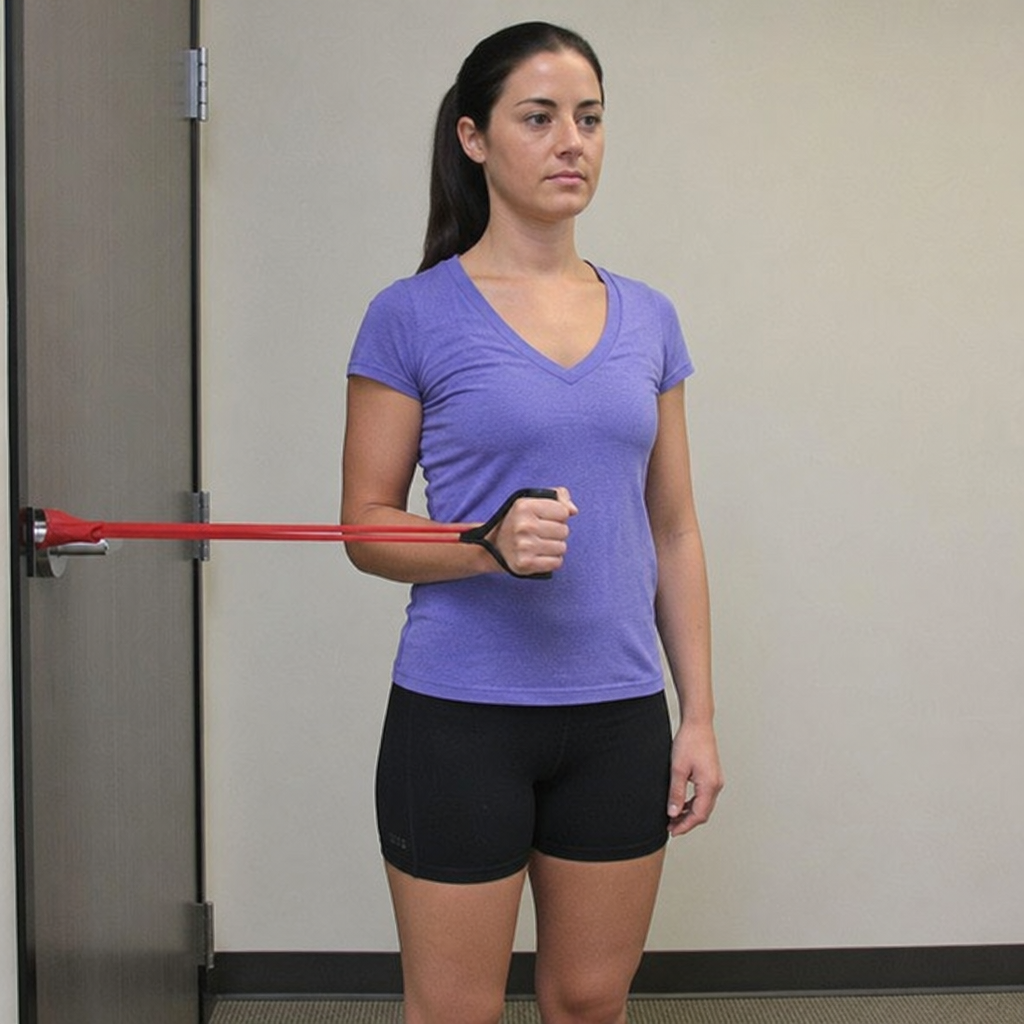
Resistance band external rotation:
- Attach a resistance band at elbow height
- Stand side-on, elbow bent to 90 degrees and tucked to your side
- Rotate your forearm outward against the band
- Return slowly — 3 sets of 12
Resistance band pull-apart:
- Hold a band at shoulder width, arms straight out in front
- Pull the band apart by squeezing your shoulder blades together
- Return slowly — 3 sets of 15
Scapular wall slides:
- Stand with your back against a wall
- Place arms against the wall in a “goalpost” position
- Slowly slide arms up and down, keeping contact with the wall throughout
- 3 sets of 10
Exercises for Shoulder Impingement
Impingement requires specific exercises that restore the space for tendons to move freely:
Scapular setting (foundation exercise):
- Sit or stand with good posture
- Gently draw your shoulder blades down and back — as if putting them in your back pockets
- Hold for 5 seconds, then release
- 10 repetitions — do this throughout the day
Prone T-raises (lower trapezius):
- Lie face down on a bed, affected arm hanging off the edge
- With thumb pointing up, raise your arm out to the side to shoulder level
- Squeeze your shoulder blade in toward your spine
- Hold for 3 seconds — 3 sets of 10
Supported flexion (overhead reaching):
- Lie on your back holding a stick or broom handle with both hands
- Use your good arm to push the affected arm up overhead
- Go as far as comfortable without pain
- 10 repetitions — increase range gradually over days
These exercises for shoulder impingement retrain the scapular muscles to control the shoulder blade properly, creating more space for the tendons.
Doing the exercises but not seeing progress? If two or three weeks of consistent effort hasn’t shifted things — or you’re not sure you’re doing them right — that’s exactly when hands-on physiotherapy makes the difference. We’ll refine your technique, add manual therapy, and progress your programme safely.
At-Home Shoulder Pain Exercises
These shoulder pain exercises at home require minimal equipment and can be done daily:
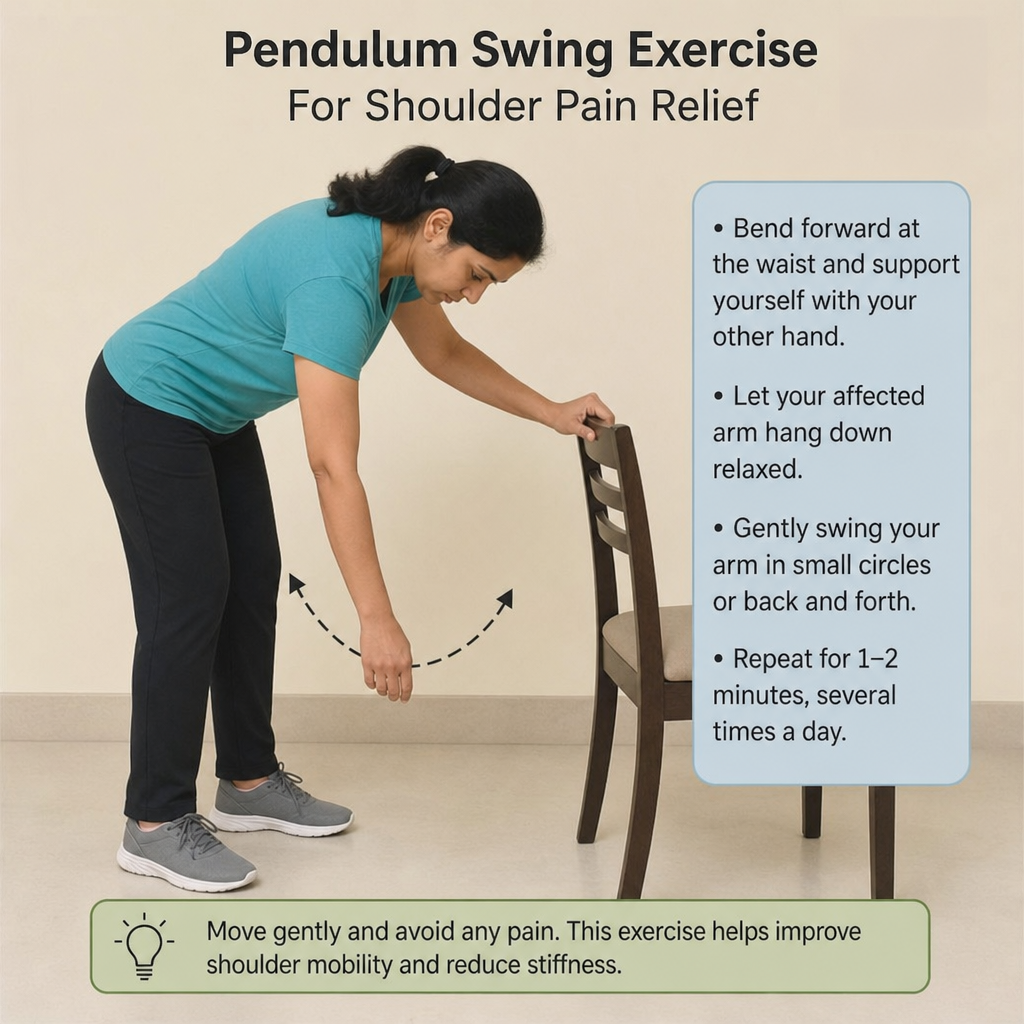
Pendulum swings (acute pain relief):
- Lean forward supporting yourself with your good arm on a table
- Let your affected arm hang down relaxed
- Gently swing the arm in small circles — clockwise then anticlockwise
- 1 minute each direction, 3 times daily
This provides pain relief by gently mobilising the joint without loading the tendons.
Wall walks (range of motion):
- Face a wall, place your fingertips on it at waist height
- Walk your fingers up the wall as high as comfortable
- Hold for 5 seconds at the top, then walk back down
- Repeat 10 times — aim to go slightly higher each day
Towel stretch (internal rotation):
- Hold a towel behind your back — good hand on top, affected hand below
- Gently pull upward with the top hand to stretch the affected shoulder into internal rotation
- Hold for 20–30 seconds
Physiotherapy for Shoulder Pain
When exercises alone aren’t progressing fast enough, physiotherapy for shoulder pain provides targeted hands-on treatment combined with expert exercise prescription.
Role of Physiotherapy in Shoulder Pain Treatment
At Westway Clinic, shoulder pain physiotherapy includes:
- Thorough assessment — identifying exactly which structure is causing pain (rotator cuff, bursa, capsule, AC joint)
- Manual therapy — joint mobilisation, soft tissue release, and trigger point work
- Personalised exercise programme — specific to your diagnosis, not generic stretches
- Movement retraining — correcting shoulder blade control and overhead patterns
- Taping — to offload painful structures while you rehabilitate
- Progressive loading — structured return to sport, gym, or overhead work
Treatment Techniques Used in Physiotherapy
Your physio for shoulder pain may use:
- Joint mobilisation — restoring movement in stiff shoulder or thoracic joints
- Soft tissue massage — releasing tight pectorals, upper trapezius, and posterior capsule
- Dry needling/acupuncture — reducing muscle tension and pain
- Exercise therapy — the core of treatment, progressed over 6–12 weeks
- Education — understanding your condition, what to avoid, and how to self-manage
Benefits of Physiotherapy for Rotator Cuff Injuries
Rotator cuff injury treatment through physiotherapy is effective for the majority of tears — even many full-thickness tears in older adults can be managed without surgery:
- Reduces pain through targeted exercise and manual therapy
- Strengthens the remaining rotator cuff muscles to compensate
- Restores functional range of motion
- Avoids surgical risks and lengthy post-operative rehabilitation
- Most patients achieve significant improvement within 6–12 weeks
Surgery is typically only considered for acute traumatic tears in younger active individuals, or when 3–6 months of quality physiotherapy hasn’t achieved adequate improvement.
Expert Tips for Shoulder Pain Relief
Preventative Measures for Shoulder Pain
- Maintain good posture — avoid rounded shoulders; sit and stand tall with shoulder blades gently drawn back
- Strengthen your rotator cuff — even when pain-free, maintain band exercises 2–3 times per week
- Warm up before overhead activity — pendulum swings, band pull-aparts, and arm circles before sport or gym
- Progress gradually — don’t suddenly increase overhead volume (painting, swimming, weights)
- Sleep position — if one shoulder is painful, sleep on the opposite side with a pillow supporting the affected arm
- Workstation setup — keep your mouse and keyboard close to prevent sustained reaching
When to Seek Professional Help
Seek immediate medical attention if you experience:
- Shoulder pain following a significant fall or impact with inability to move the arm
- Visible deformity of the shoulder (possible dislocation)
- Sudden severe weakness — inability to lift the arm at all after an injury
See your GP or physiotherapist promptly if:
- Pain has lasted more than 3–4 weeks with no improvement
- Pain is disturbing your sleep regularly
- You’re losing range of movement progressively (possible frozen shoulder)
- Weakness is affecting daily tasks (dressing, lifting the kettle)
- Pain is accompanied by clicking, catching, or the shoulder feeling unstable
Don’t wait until the shoulder freezes up — early rotator cuff pain relief through exercise and physiotherapy produces the best outcomes.
Ready to get your shoulder pain sorted? You don’t need to wait weeks to see if it settles. The sooner we assess you, the sooner you recover — and the less likely it is to come back.
Book your shoulder pain assessment at Westway Clinic, Redhill.
Q&A
Recovery and Self-Management
Question: How long does shoulder tendonitis take to heal?
Short answer: Most cases improve significantly within 6–12 weeks of consistent exercise. Mild cases may settle in 3–4 weeks. Long-standing tendonitis (3+ months) can take 3–6 months of progressive loading to fully resolve. The key is consistency — doing your exercises daily, not just when it hurts. Stopping too early is the most common reason for recurrence.
Question: Should I rest my shoulder completely or keep moving it?
Short answer: Keep moving within comfortable limits. Complete rest weakens the rotator cuff and can lead to stiffness or frozen shoulder. Avoid aggravating activities (heavy overhead lifting, reaching behind your back forcefully), but do your prescribed exercises daily and maintain gentle movement. Think “relative rest” — protect it from overload while keeping it active.
Exercise and Training
Question: Can I still exercise at the gym with shoulder pain?
Short answer: Yes, but modify. Avoid exercises that reproduce your pain — typically overhead pressing, lateral raises above shoulder height, and behind-the-neck movements. Keep training lower body, core, and non-painful upper body exercises. Your physiotherapist can advise which specific movements to modify and when to reintroduce them progressively.
Understanding Your Diagnosis
Question: What’s the difference between tendonitis, impingement, and a rotator cuff tear?
Short answer: They’re closely related. Tendonitis means the tendon is irritated/inflamed. Impingement means the tendon is being pinched between bones (often causing tendonitis). A tear means the tendon fibres have actually ruptured — partially or fully. All three cause similar symptoms (pain with lifting/reaching, night pain), but tears may also cause notable weakness. A physiotherapist can differentiate through specific clinical tests.
Question: Is shoulder pain at night a sign of something serious?
Short answer: Night pain is very common with rotator cuff problems and doesn’t necessarily indicate something serious. It occurs because lying down changes pressure on inflamed tendons. However, try sleeping on your back or opposite side with a pillow supporting the affected arm. If night pain is your only symptom (no daytime pain or injury), or if it’s accompanied by unexplained weight loss or constant worsening, see your GP to rule out other causes.
Frequently Asked Questions
-
What are the best exercises for shoulder pain relief?
Start with isometric rotator cuff exercises (pushing into a wall without movement) and pendulum swings for pain relief. Progress to resistance band external rotation, scapular setting, and wall slides as pain settles. For shoulder tendonitis specifically, eccentric (slow lowering) exercises are the gold standard. A combination of stretching, strengthening, and scapular control exercises provides the most comprehensive shoulder pain relief.
-
Can shoulder impingement be cured with exercises?
Yes — the majority of shoulder impingement cases resolve with targeted exercises. The key is strengthening the rotator cuff and scapular stabilisers (lower trapezius, serratus anterior) to improve shoulder blade control and create more space for the tendons. Most people see significant improvement within 6–12 weeks of consistent exercises for shoulder impingement. Surgery is rarely needed.
-
How often should I do shoulder exercises?
For active pain: gentle mobility and stretches daily (pendulum swings, cross-body stretch). Strengthening exercises 3–4 times per week with rest days between. Isometric exercises can be done daily as they don’t stress the tendon. Once pain settles, maintain rotator cuff exercises 2–3 times per week permanently to prevent recurrence.
-
Is physiotherapy effective for shoulder pain?
Yes — physiotherapy is the first-line treatment recommended by NICE for most shoulder conditions including rotator cuff problems, impingement, and tendonitis. It combines hands-on treatment, targeted exercises, and education. Most patients see significant improvement within 6–12 sessions. It’s particularly effective when combined with a consistent home exercise programme.
-
When should I consider surgery for shoulder pain?
Surgery is typically only considered after 3–6 months of quality physiotherapy with inadequate improvement. Exceptions include acute traumatic full-thickness rotator cuff tears in younger active patients, dislocations with structural damage, or fractures. For degenerative rotator cuff tears, impingement, and tendonitis, physiotherapy is as effective as surgery in the majority of cases — without the risks and recovery time.
What our clients say
Key Takeaways
- Most shoulder pain responds well to targeted exercises and physiotherapy — surgery is rarely needed
- The rotator cuff is central to most shoulder problems — strengthen it with resistance band exercises
- Start with isometric exercises and pendulums when pain is acute, progress to loaded strengthening as pain allows
- Address shoulder blade control — weak scapular muscles are a common underlying cause
- Don’t rest completely — gentle movement prevents stiffness and frozen shoulder
- Physiotherapy for shoulder pain accelerates recovery and prevents recurrence
- Seek help if pain persists beyond 3–4 weeks, sleep is regularly disturbed, or you’re losing range of movement
Clinically reviewed by Jawad Ahmed, HCPC-registered Physiotherapist, Westway Clinic, Redhill, Surrey. Last updated: July 2025.
Disclaimer: This information is for educational purposes and does not replace individual clinical assessment. If you are experiencing severe or worsening symptoms, please seek professional assessment.